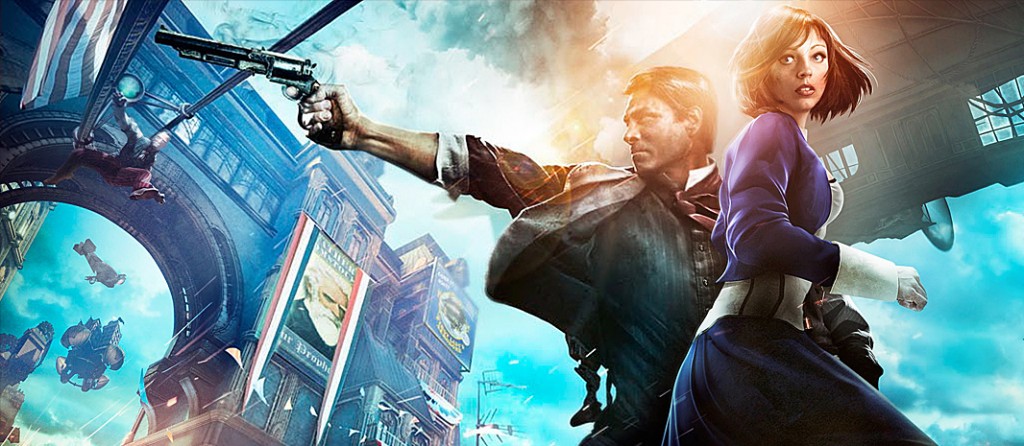
“Bring us the girl, wipe away the debt.” These few words are the catalyst that set the grand scheme of BioShock Infinite in motion, forcing protagonist Booker DeWitt to travel to the industrious floating city known as Columbia in search of a young woman named Elizabeth. Buried deep in dept within his own gambling addiction and alcoholic stupors, this appears to be Booker’s only chance at saving himself from further destruction. But Columbia’s stark fanaticism and political zeal aren’t the only issues he’ll have to deal with, as the mysterious “A.D.” brand on his right hand marks him as the so-called False Shepherd, sending the whole city into a violent uproar.
Infinite’s unflinching portrayal of early 20th century racism and religious extremism may a bit too uncomfortable for some people to take, as the game spares no expense to tell its story. At the top of the mountain is Zachary Hale Comstock, the founder of Columbia. His indignation is an iron fist, as the people of Columbia worship him as both savior and Prophet. He proclaims to have seen all possible futures, and has predicted that the False Shepherd would come to steal away the Lamb of Columbia – Elizabeth. Booker’s struggle through the many layers of this floating kingdom will have him fending off countless Columbian nationalists, mechanical monstrosities, and more as he seeks to rescue Elizabeth and return her to those who desire her. But the deeper Booker finds himself involved in Columbia’s political battle between Comstock’s men and the rejected society known as the Vox Populi, the less likely it seems he’ll ever make it out alive.
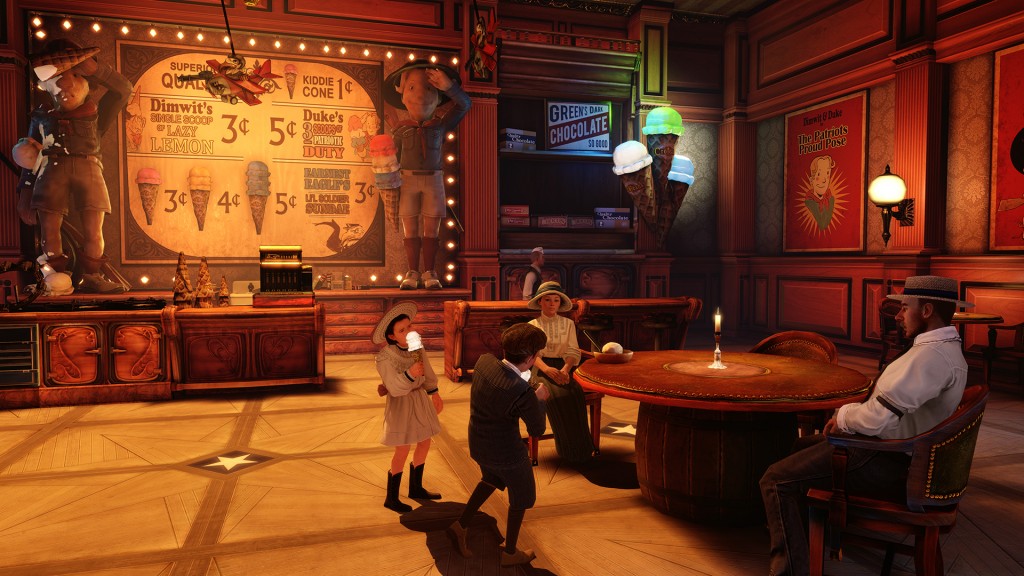
Enjoying a bit of ice cream amidst all the turmoil.
Fans of Irrational Games’ previous BioShock will find entrance into Infinite very accessible. Plasmids are replaced by Vigors, which are fundamentally the same thing: abilities that enhance the player’s control and provide alternative means to combat. You’ll find an assortment of standard firepower throughout the game, some more useful than others. There are a few new additions to the franchise, particularly the skyhook and the collection of outfits. The former is a tool used to navigate many of Columbia’s disconnected aerial locations, but has value in combat as well. You can perform a devastating landing attack on enemies by dropping from the skyline, in addition to using it for some more tactical advantages like getting the high ground or finding ammo caches. The outfits are collectible pieces of gear that affect your abilities in combat by increasing the damage of certain Vigors or weapons, by raising the drop rate of ammo upon an enemy’s death, or other benefits. Their effect is random to a degree: each one is coded into the game, but when you pick one up it may not always be the same thing.
Perhaps the most ambitious feature of BioShock Infinite is Elizabeth herself, and not since Half-Life 2’s Alyx Vance has there been a companion character that has behaved so naturally in the world and fulfilled the role of cooperative partner so well. She’ll scavenge for ammo, health, and money for you, and even though it’s left up to chance, she’ll definitely save your life on more than a few occasions. But more than that, she is the star of the show: while it’s through Booker’s eyes you witness the adventure, ultimately, it is Elizabeth’s tale that is at the core of BioShock Infinite. The mysteries surrounding her imprisonment, existence, and why Booker’s employers desire her so much serve as some of the game’s final surprises. And make no mistake, the ending will leave much room for discussion and will most certainly require a secondary playthrough.
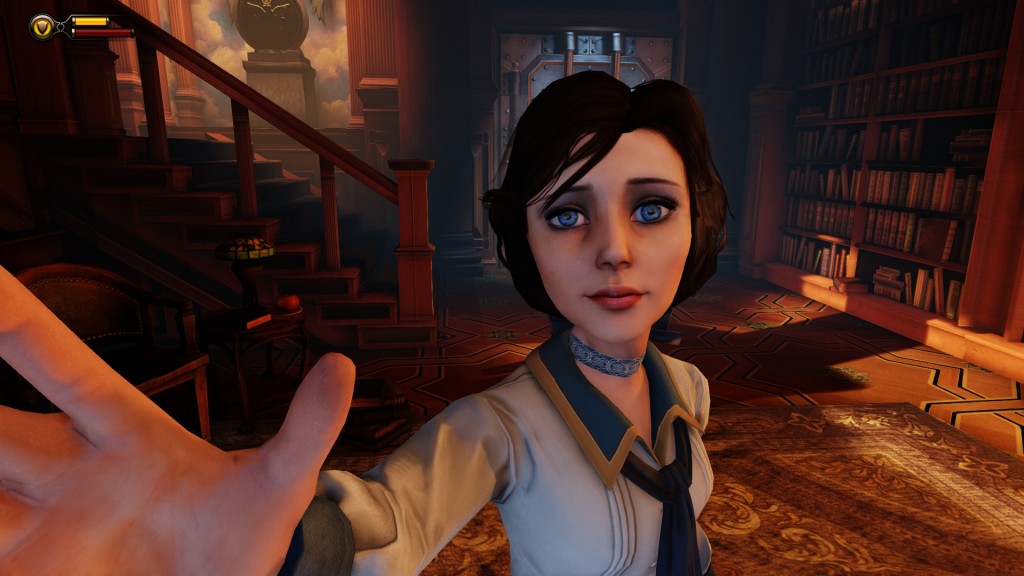
Elizabeth’s personality, behavior, and movement are unlike anything else.
The city of Columbia is a star in its own right, and like Rapture, evokes a number of different ideological and social extremisms. Rapture’s submerged dwelling belied its capitalistic leader, Andrew Ryan: it was oppressive and claustrophobic, dark and haunted. It was a city that looked down upon censorship of art and media, where morality was in absence, and where every individual was encouraged to take their own piece of paradise. And yet there was just something not quite appropriate about it sitting at the bottom of the ocean. On the contrary, Columbia’s “fortress in the sky” ambition is its own form of dramatic irony: free of constraints and boundaries, Columbia is more sectionalist and segregated. Comstock’s word is law and racial and religious discrimination runs rampant. The two settings – Rapture and Columbia – are at once equal and opposite, two sides of the same coin. And this is by no means accidental. But that discussion is for another place, at another time.
Infinite’s portrayal of many of its themes hits a few high notes, particularly much of its more existential questions at the back end. Its racial and religious contrivances falter a bit but they serve their place in the overall picture. Much of that will fall in line upon the second playthrough more than they might in the first, once players fully grasp the context of the game. Perhaps the largest issue is the game’s reliance on the old and familiar. Make no mistake, the story, cast, and soundtrack set BioShock Infinite ahead of the pack and a forerunner for Game of the Year, but the gunplay still feels very typical. This is by no means a fault, as the action is certainly more fluid. But it almost feels like the game tries to fall back into shooter-mode too often, which sharply contrasts some of the more passive sections.

You’ll encounter these two throughout the game, often comedic but always important.
Of course the skyhook livens things up a bit, and the enemy AI behaves exceptionally well, but at the end of the day the mechanical experience of the game won’t differ too much to what you played in the original BioShock. In fact, much of the non-combat procedures have been removed entirely (for better or worse): hacking is gone and provided you have enough lock picks, Elizabeth will perform that action for you. The game never feels more redundant than a certain portion near the tail end, roughly an hour or two before the game’s final battle. There’s a stretch where you’ll fight the same boss enemy three times in a row, all while performing what ultimately amounts to a needless fetch quest. It felt entirely like fluff or padding to lengthen the game, and as a whole, there could have been a number of sections throughout that were removed to create a more succinct package.
Aside from these few encounters and perhaps the game’s climax, which is more or less an accumulation of combat strategies you’ve learned up to that point, the game rarely feels cheap. In fact, with Elizabeth’s aid, I strongly recommend playing on the hard difficulty, as you’ll get the fullest experience out of the game’s strong enemy AI and Elizabeth’s practical scavenging. Should you fall in combat, checkpoints are scattered generously throughout a level, so at most you’ll be set back a door or two and with a few coins lost. For ultimate thrill-seekers, 1999 Mode unlocks upon completion, which serves as an extreme or very hard mode, upping the scarcity of ammo and money found in the world and increasing all aspects of the enemy as well as the monetary cost of death.
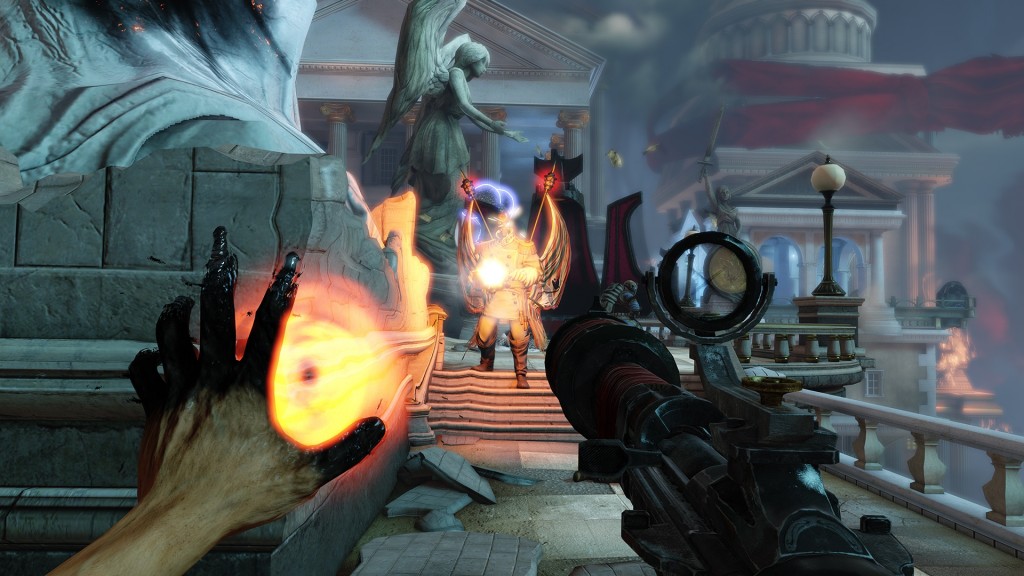
The motorized patriot, one of the more frequent heavy hitters of the game.
While Booker and Elizabeth function as the game’s heroes, the supporting cast are equally delightful (or intentionally not so much), with one or two exceptions. Comstock is a great antagonist and his messianic preaching paints him as a very confident, proud man; however, characters like Daisy Fitzroy, leader of the rebellious Vox Populi, and Songbird, Elizabeth’s mysterious protector, could have gone in much better directions. Daisy starts out as this strong leader devoted to her people, and through some of the early Voxophones – recorded messages found throughout the game – you build up this idea of her in your head. But ultimately, the fate of her character takes a disappointingly extreme turn. Songbird, on the other hand, takes no turns whatsoever; it simply exists as the enigmatic protector of Elizabeth. Perhaps there’s room there for discussion, or potential DLC, but as it stands it feels almost like a missed opportunity.
But nothing in the game could have been achieved so effectively if not for two things: the look and sound of Columbia. In stark contrast to Rapture’s dark hues and dim lighting, Columbia flies in the face of the sun. Brightly lit, colorful, and with a glossy sheen over it, its picture-perfect look hides its dark and seedy undertones. The city feels alive, as well, as the different interconnected portions of Columbia sway like independent structures. You’ll occasionally stumble upon conversation between characters that has absolutely nothing to do with your situation, and other times, you may hear something that you don’t know is foreshadowing future events. The game, without question, looks infinitely better on PC than it does on consoles, and if you have any choice whatsoever, you know the way to go. Ultimately both console versions have reduced draw distance and just a general glazed, filmy look to the world. The PS3 copy suffers a bit from excessive screen tearing and the Xbox 360 version has a number of texture pop-ins. There’s not a whole lot that will break the experience, but why rob yourself of a greater presentation if it’s possible? Otherwise there are a few inconsistencies here and there across all versions, like an NPC not moving out of your way, or audio overlap.
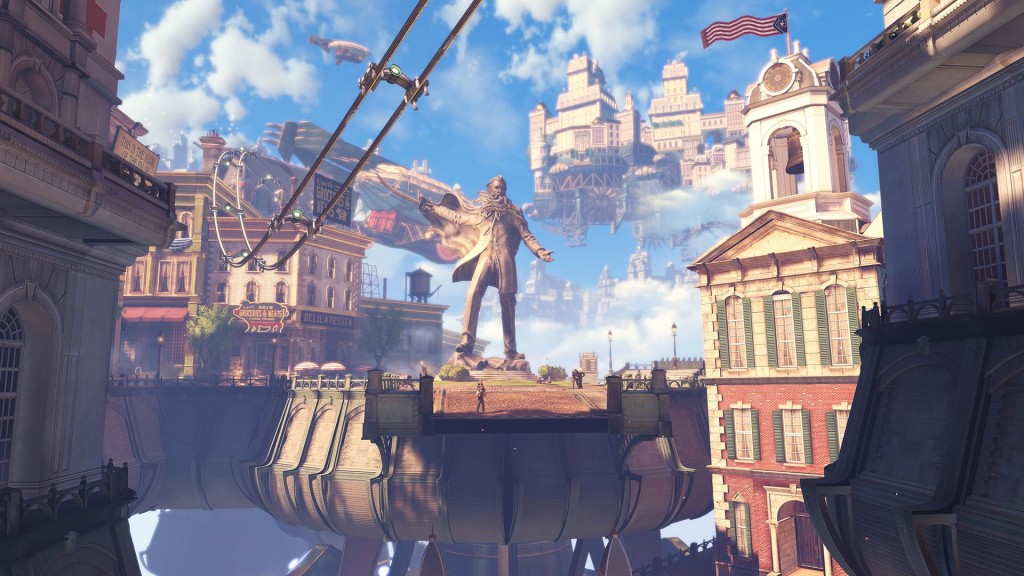
One of the first sights you’ll see upon entrance into Columbia proper.
The team at Irrational has crafted a story and universe that simply demands to be explored further, whether through discussion or by replaying the game. It’s not so much that you’ll get a different experience, because despite whatever choices there are in the game, none of them affect the outcome; it’s that those seemingly insignificant, binary choices are actually part of the discussion. That conversation you heard that made no sense originally now has context. Those pictures you saw, the music you heard – all of it has meaning the second time through. The music, especially, is incredibly powerful, and stands on its own as the most inspiring part of BioShock Infinite. Whether it’s one of the game’s original scores or a licensed piece of music, there isn’t a single part of the game’s soundtrack that doesn’t just fit and sound wonderful. It’s more than just good background noise, as well, as music plays a key role in the story and overall structure of the world. Nothing is without purpose.
There’s much to be discussed about BioShock Infinite. In itself, it’s not a fairly difficult game to review: while the gameplay manages to provide some new enjoyment, it’s everything else that keeps it floating high above its competition. But it is a near impossible game to discuss to anyone who has not yet finished it. Simply writing this review has tested my patience and ability to not spoil anything, and yet I can’t help but talk about or slyly reference what I know. That is a credit to Irrational Games. They have managed to capture an audience with thought-provoking questions about existence, about life, and about guilt. So few games come along that truly demand discussion or analysis. BioShock Infinite’s ending may not be the greatest of all time like many claim, but it is absolutely one of the most well-constructed. Because it’s not the ending alone that makes it so special, it’s what you know and what you’ve seen that creates the magic.
Leave a Reply